A 4B GlanceNav trained without external data, on R2R-CE and RxR-CE val-unseen.
71.9%
success rate on R2R-CE, +9.1 over the best previous single-RGB method without external data
73.6%
success rate on RxR-CE, +7.6 over the best previous method without external data
104ms
per step on an RTX PRO 6000, constant over the whole episode
8.6×
fewer frames encoded per training epoch than step-wise training
Abstract
Abstract
Multimodal large language models (MLLMs) have become strong policies for vision-and-language navigation (VLN). However, most of them encode a sample of past frames again at every decision and are trained on isolated decisions, so computation is redundant and the usable history is short. They also learn from their own mistakes through outcome rewards that give one scalar to a whole episode. We ask whether a navigator can encode each frame only once, at a constant cost per step, and still remember what matters and learn efficiently from its mistakes.
We present GlanceNav, a streaming navigator built on a hybrid MLLM. Its Gated DeltaNet layers carry a recurrent state through the whole episode, while its attention layers keep a short window of recent observations and a small bank of keyframes, selected by how much each frame changes the recurrent state. This constant-size memory keeps the cost per step fixed and allows training on whole episodes with the same memory as at inference. Because the entire memory can also be copied in constant time, we further propose Counterfactual Rewind (CoRe), a reinforcement learning stage that rewinds a drifting rollout to its closest approach to the goal, lets an expert correct a few actions, and credits decisions by the resulting change in outcome.
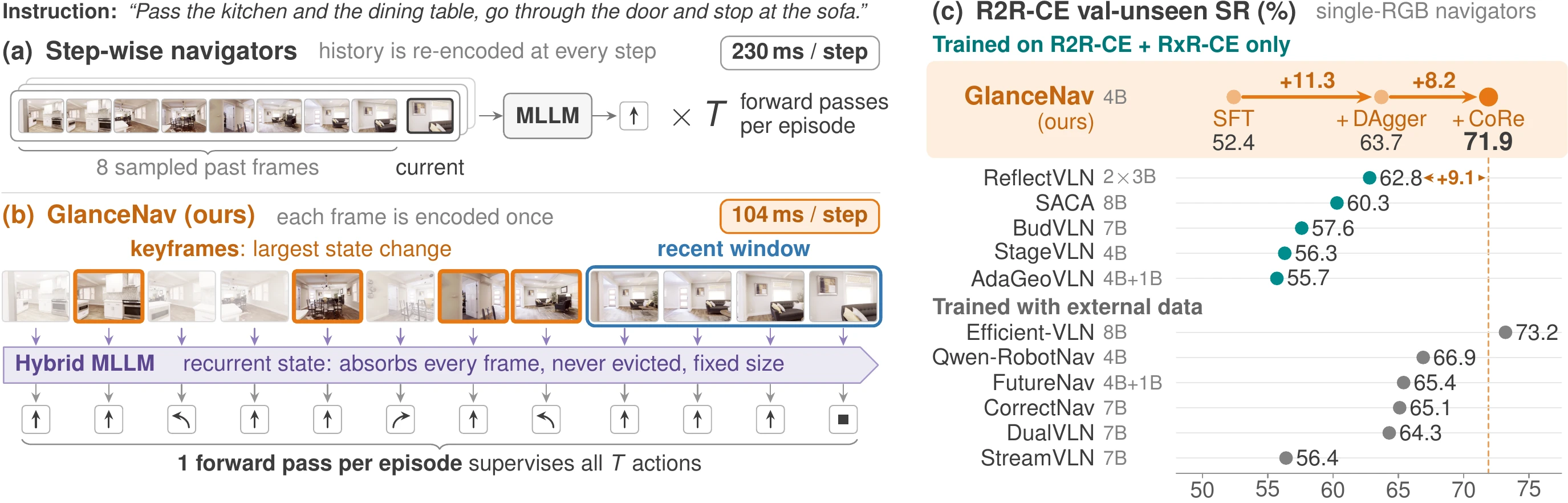
Trained only on the R2R-CE and RxR-CE training splits, with 1,000 instructions for reinforcement learning, a 4B GlanceNav reaches success rates of 71.9% and 73.6% on R2R-CE and RxR-CE val-unseen. On R2R-CE, it outperforms the strongest previous single-RGB method trained without external data by 9.1 points, while running at 104 ms per step.
Overview
Step-wise vs. streaming navigation
Most MLLM navigators treat each step as video question answering and re-encode about eight sampled frames at every decision. GlanceNav encodes each frame once and keeps a fixed-size memory.
GlanceNav at a glance. (a) Step-wise navigators repeatedly encode sampled historical frames at each decision. (b) GlanceNav encodes each frame once, maintaining a recurrent state alongside a fixed-size window of recent observations and selected keyframes, which enables episode-level training with the same memory used at inference. Step latency is measured on an RTX PRO 6000, against StageVLN with a similarly sized backbone. (c) Success rates of single-RGB navigators on R2R-CE val-unseen; arrows show the gains of our three training stages.
Problem 1 · memory
Re-encoding is redundant, and eviction is final
Each frame is processed again for every later decision that samples it, and the policy cannot see what falls outside the sample. Streaming KV caches avoid re-encoding but grow with the episode, so they are bounded, and whatever leaves the cache is gone.
Problem 2 · learning from mistakes
One scalar for ~100 decisions
Outcome-based RL such as GRPO gives one reward to a whole rollout and learns mostly from instructions with mixed success and failure, which become rarer as the policy improves.
Method
A constant-size streaming memory
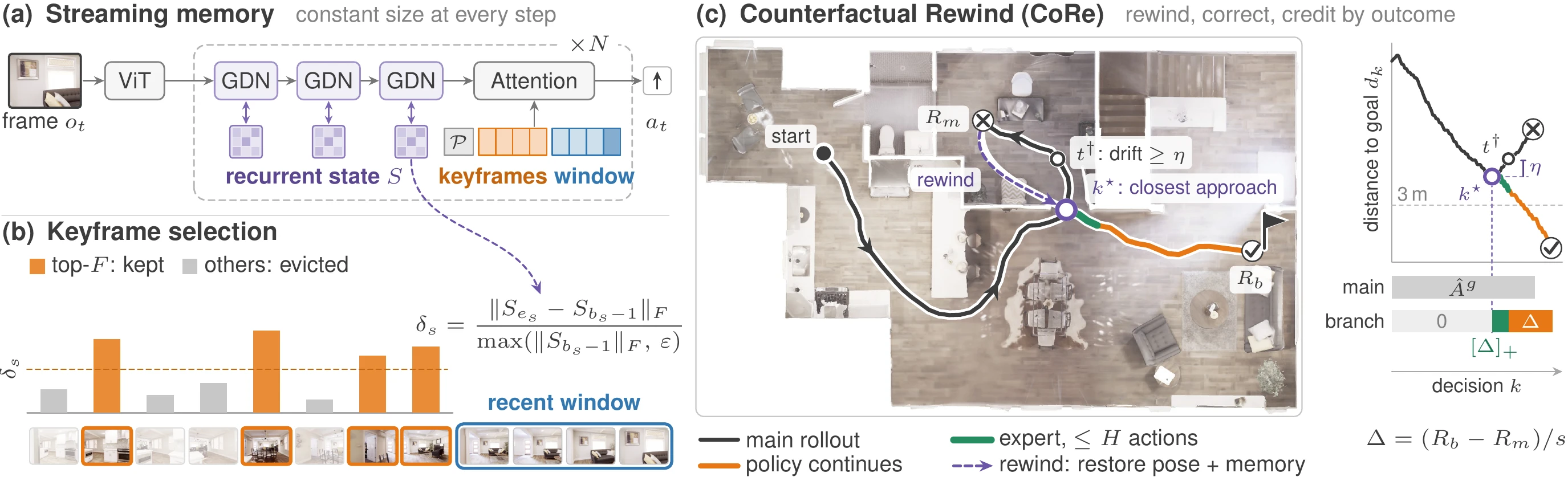
GlanceNav builds on a hybrid MLLM (Qwen3.5-4B). Most of its layers are Gated DeltaNet (GDN) layers that fold every token into a fixed-size recurrent state; a few are softmax attention. The question becomes not which history to keep, but which few frames should also be kept exactly.
Overview of GlanceNav. (a) Each frame is encoded once. GDN layers update recurrent states, while attention retains the instruction prefix, recent steps, and selected keyframes within a fixed memory budget. (b) Frames are scored once by their relative recurrent-state change δs; on leaving the recent window they compete for a layer-specific top-F bank. (c) CoRe (training only) restores the pose and full memory at k*, the closest approach before the drift trigger t†, lets an expert supply at most H corrective actions, and credits by the branch–main return difference.
Recurrent state
GDN states are carried through the whole episode and never evicted. They summarize every observation in a fixed-size state (48 MiB), whatever the episode length.
Recent window
Each attention layer keeps the exact KV rows of the instruction prefix and the W = 4 most recent steps, with their visual and action tokens.
Keyframe bank
Frames that leave the window compete for F = 4 slots per attention layer, ranked by how much they changed the recurrent state below. Kept rows are never re-encoded.
The state-change score
A frame that the state already predicts barely changes it; a frame with new content, such as a new room, changes it a lot and is kept. The score has no parameters and is computed once, when the frame is encoded:
\delta^{(\ell)}_s=\frac{\lVert S_{e_s}-S_{b_s-1}\rVert_F}{\max\big(\lVert S_{b_s-1}\rVert_F,\ \varepsilon_\ell\big)}relative change of the GDN state below attention layer ℓ across the token span [bs, es] of frame s
Unrolling the gated delta rule over a frame shows what the score measures: the frame scores high if the state could not predict it (large residuals are written), or if it makes the state forget, as at a room transition.
Keyframes are selected from the past only, so the memory of every step can be built inside one forward pass over a whole episode with a block-sparse attention mask. GlanceNav is trained on entire episodes with exactly its test-time memory, instead of on isolated decisions. The training and streaming paths agree on the top response token in 99.5–100% of cases.
Step-wise
Episode-level (ours)
History per decision
8 sampled frames
state + window + bank
Frames encoded per epoch
27.0M
3.13M
Decisions per forward pass
1
102
Training time per epoch (4× H100)
42.6 h
13.5 h
R2R-CE SR / SPL
46.5 / 42.3
52.4 / 48.7
Same Qwen3.5-4B backbone and data (30.8K episodes, 3.13M actions), one epoch. The step-wise model comes from a separate code base, so the SR row compares two systems.
Reinforcement learning
Counterfactual Rewind (CoRe)
Because the memory has a constant size, a snapshot of the agent's entire memory takes 136 MiB and 1.4 ms to copy at any step. CoRe uses these snapshots to turn a drifting rollout into a contrast between two outcomes from the same state.
Detect drift
A rollout is triggered at the first decision t† where it is a margin η = 1 m farther from the goal than its best so far.
Rewind
Restore the simulator pose and the full streaming memory at k*, the rollout's closest approach to the goal, in O(1).
Correct
A shortest-path expert redoes at most H = 16 actions, written into the agent's own memory; then the policy finishes the episode.
Credit by outcome
The branch–main return difference Δ credits the policy's continuation, and the expert's actions only when the branch did better.
\Delta_b=\frac{R_b-R_m}{s},\qquad w_{t,j}=\begin{cases}\hat A^{g} & \text{main rollout}\\ \Delta_b & \text{policy continuation}\\ \max(0,\Delta_b) & \text{expert correction}\\ 0 & \text{shared prefix}\end{cases}a counterfactual Q-filter estimated by a rollout instead of a learned critic. With no trigger, CoRe reduces to GRPO.
Why the closest approach? At the trigger t†, the agent is already lost: 80% of expert actions there are turns toward a goal it cannot see, and the policy learns to spin. At k*, the expert instead redoes the moves with which the agent left its best position. Branching at k* rescued 12 of 16 failed rollouts in a probe, against 6 at t†.
Training stages
R2R-CE val-unseen SR. RL rows use one pass over the same 1,000 mixed R2R-CE + RxR-CE instructions (500 from each), with the same order and seed.
Groups that still carry a training signal
Share of instruction groups with an outcome contrast, by quarter of RL training.
As GRPO improves, fewer groups mix success and failure (64% → 36%). CoRe keeps about 60% of groups informative; 75% of its branches succeed and they rescue 53% of failed main rollouts.
Results
Comparison with the state of the art
GlanceNav (4B, no external data) against single-RGB navigators on R2R-CE and RxR-CE val-unseen. In the table, best and second best among single-RGB methods are in bold and underlined.
Model performance comparison
Success rate (%) of single-RGB navigators, val-unseen
GlanceNav (ours, 4B)Prior single-RGB methodsTrained on R2R-CE + RxR-CE only
R2R-CE val-unseen
RxR-CE val-unseen
Method
Backbone
NE↓
OS↑
SR↑
SPL↑
NE↓
SR↑
SPL↑
nDTW↑
Panoramic, depth or multi-view input (for reference)
GridMM
–
5.11
61.0
49.0
41.0
–
–
–
–
Reborn
–
5.40
57.0
50.0
46.0
5.98
48.6
42.1
63.4
NavMorph
–
5.75
56.9
47.9
33.2
8.85
30.8
22.8
44.2
AgentVLN
3B
3.88
73.5
67.2
64.7
3.92
69.5
61.3
74.6
OmniNav‡
3B
3.74
74.6
69.5
66.1
3.77
73.6
62.0
–
Qwen-RobotNav‡
8B
3.53
78.5
72.1
66.6
3.58
76.5
65.7
72.5
Single RGB, trained with external data
NaVid
7B
5.47
49.1
37.4
35.9
8.41
23.8
21.2
–
Uni-NaVid
7B
5.58
53.3
47.0
42.7
6.24
48.7
40.9
–
ActiveVLN
3B
5.31
58.3
50.1
43.7
5.84
50.7
41.2
58.1
NaVILA
8B
5.22
62.5
54.0
49.0
6.77
49.3
44.0
58.8
InternVLA-N1 (S2)
7B
4.89
60.6
55.4
52.1
6.41
49.5
41.8
62.6
NavFoM
7B
5.01
64.9
56.2
51.2
5.51
57.4
49.4
60.2
StreamVLN
7B
4.90
63.6
56.4
50.2
5.65
54.4
45.4
63.7
JanusVLN†
7B+1B
4.78
65.2
60.5
56.8
6.06
56.2
47.5
62.1
NaVIDA
3B
4.32
69.5
61.4
54.7
5.23
57.4
49.6
67.0
DualVLN
7B
4.05
70.7
64.3
58.5
4.58
61.4
51.8
70.0
SACA
8B
4.19
69.3
64.7
56.9
4.75
62.1
51.7
66.0
CorrectNav
7B
4.24
67.5
65.1
62.3
4.09
69.3
63.3
75.2
FutureNav†
4B+1B
4.24
70.2
65.4
61.3
4.60
60.9
52.8
68.0
Qwen-RobotNav
4B
4.22
73.6
66.9
60.5
4.15
71.3
61.5
68.6
Qwen-RobotNav
8B
4.36
72.7
65.7
59.6
4.16
73.4
63.5
69.9
SeekVLN
8B
3.7
75.2
67.5
61.4
4.9
59.7
50.3
63.6
Efficient-VLN
8B
3.29
78.2
73.2
65.0
3.18
75.6
60.0
–
Single RGB, R2R-CE and RxR-CE only: expert demonstrations
JanusVLN†
7B+1B
5.17
58.0
52.8
49.2
6.46
51.4
44.3
59.1
FutureNav†
4B+1B
5.13
61.8
55.1
50.1
5.62
54.5
46.0
61.8
AdaGeoVLN†
4B+1B
5.27
60.7
55.7
51.4
5.64
54.1
44.7
61.8
StageVLN
4B
5.17
64.7
56.3
51.4
5.65
54.3
42.8
58.3
Single RGB, R2R-CE and RxR-CE only: demonstrations and on-policy training (DAgger, recovery data or RL)
MonoDream
2B
5.45
61.5
55.8
49.1
6.38
49.4
40.9
–
BudVLN
7B
4.74
65.6
57.6
51.1
5.79
56.1
46.6
63.2
SACA
8B
4.57
64.9
60.3
55.1
4.90
60.3
49.8
62.1
ReflectVLN
2×3B
4.19
67.3
62.8
58.5
3.98
66.0
57.2
–
GlanceNav (ours)
4B
3.32
78.6
71.9
63.7
3.55
73.6
59.6
70.7
† additional geometry encoder. ‡ multi-view RGB. Gray rows use panoramic, odometry, depth or multi-view input and are shown for reference only. Published numbers as reported by each method.
Efficiency
Constant cost per step
Each step processes only the tokens of one new observation. Attention reads a bounded number of rows and the GDN state has a fixed size, so step time stays flat along the episode.
Step time at batch size 1
Milliseconds per policy call; lower is better.
Full KV cache vs. bounded memory
Median step time (ms) along a 500-step episode, same backbone, RTX PRO 6000.
RTX 5090
RTX PRO 6000
Jetson AGX Orin
Method
GiB↓
ms↓
GiB↓
ms↓
GiB↓
ms↓
JanusVLN
OOM
OOM
35.73
481.3
35.7
7389.8
NaVILA
17.47
365.2
17.47
383.1
17.5
3531.0
StreamVLN
17.48
233.4
17.48
209.8
17.6
2135.5
StageVLN
10.24
304.5
10.24
229.8
10.2
2175.8
GlanceNav
8.68
135.7
8.68
103.9
8.9
839.1
Peak VRAM and step time per policy call (StreamVLN may emit up to four actions per call). Desktop baselines from StageVLN; Jetson numbers measured with the same protocol. OOM: out of memory on the 32 GB RTX 5090.
Ablations
What makes it work
Each row is a separately trained model.
Memory budget
Stage-1 val-unseen SR. Frames = W + F visible to an attention layer.
Memory
W
F
Frames
R2R-CE
RxR-CE
Window only
4
0
4
48.7
55.0
8
0
8
49.0
55.3
12
0
12
51.2
56.7
Window + bank
2
4
6
49.2
56.2
4
2
6
50.8
58.3
ours
4
4
8
52.4
56.6
4
8
12
51.3
57.4
8
4
12
51.0
56.0
With eight visible frames, four steps plus four keyframes beat an eight-step window by 3.4 SR; a window alone needs twelve frames to come close.
Ablation of CoRe
R2R-CE val-unseen, RL on 1,000 R2R-CE instructions only (the Training stages chart uses mixed R2R-CE + RxR-CE instructions); single runs.
Method
SR
SPL
OS
GRPO, G = 4
64.3
57.3
72.4
GRPO, G = 5 (same compute)
66.5
58.7
75.2
CoRe variants
Self-rewind: policy acts in branch
67.3
59.6
74.2
Branch at the trigger t†
66.7
57.3
76.9
Imitate every correction
67.0
59.3
76.3
No credit for expert actions
64.9
57.7
74.6
CoRe (η = 1 m, H = 16)
68.7
60.9
76.7
The outcome-filtered credit on expert corrections carries most of the gain; extra GRPO rollouts at matched compute do not close the gap.
Selecting the bank
Stage-1 R2R-CE SR, W = 4, bank of four frames' worth of rows.
Selection rule
Unit
SR
SPL
Window only
–
48.7
45.0
Committed write β‖e‖ (HOLA)
token
51.7
48.4
Prediction error ‖e‖
token
50.1
46.5
Mean committed write
frame
49.3
45.5
New-writes term only
frame
51.6
48.7
Learned linear ranker
token
51.7
48.2
State change δs (ours)
frame
52.4
48.7
Selected rows of the ten parameter-free scores and two learned rankers in the paper. A randomly filled bank does not help at all.
DAgger labels and data
R2R-CE val-unseen, from Stage 1, one epoch. TL: trajectory length (m).
Training data
SR
SPL
OS
TL
Stage 1
52.4
48.7
58.0
9.4
DAgger, executed actions
52.0
42.4
70.3
16.0
DAgger, oracle relabeling
58.8
45.0
72.7
15.7
+ STOP correction
60.7
48.8
73.2
15.1
+ demonstrations (Stage 2)
63.7
56.7
70.6
11.2
Supervising executed actions imitates the learner's mistakes; relabeling every visited state with the expert's action adds 6.8 points with the same inputs.
Real-world deployment
Zero-shot on a Unitree G1 humanoid
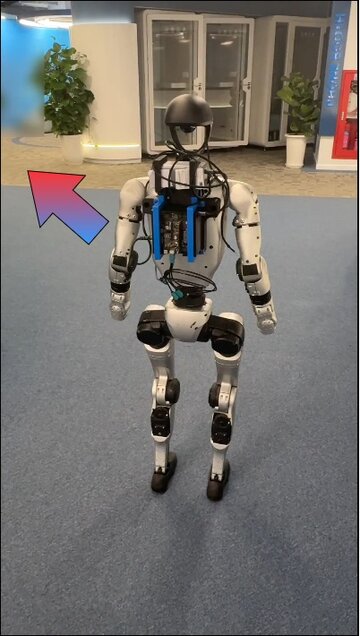
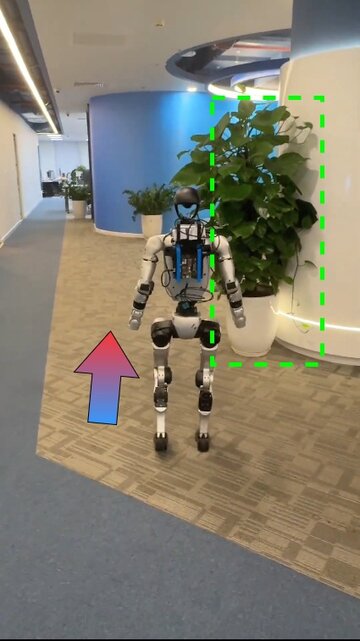
Trained only in simulation (R2R-CE and RxR-CE), GlanceNav follows free-form instructions in an unseen office building, with no fine-tuning on real-world data. As in the paper, the instructions fall into two categories, moderate-length (T1) and long-range (T2). Every video is an uncut rollout, shown at 2× speed.
T1 · Moderate-length navigation
Tell visually similar objects apart and use their spatial or sequential relations to find the right stop.
T1 · moderate2× speed
Paper Fig. 7a
Past the game tables to the wooden cabinet
Go straight, pass the foosball table, continue past the pool table, and stop in front of the wooden cabinet.
T1 · moderate2× speed
Appendix A
Stop beside the pool table
Go straight, pass the foosball table, and stop beside the pool table.
T1 · moderate2× speed
Appendix A
Left at the fire cabinet
Go straight until you reach the red fire extinguisher cabinet, then turn left, continue straight, and stop near the potted plant on your right.
T2 · Long-range navigation
Recognize landmarks and make decisions at several points along the route.
T2 · long-range2× speed
Paper Fig. 7b
Fire cabinet to the hallway plant
Go straight until you reach the red fire extinguisher cabinet, then turn right. Continue straight along the hallway and stop in front of the potted plant at the end.
T2 · long-range2× speed
Appendix A
Plants by the blue couch
Turn left at the intersection. Continue straight past a potted plant on your right, then keep going straight and stop in front of the next potted plant near the blue couch.
T2 · long-range2× speed
Appendix A
Into the pantry, to the refrigerator
Go straight to the intersection with the red fire extinguisher box, turn right, continue straight for a short distance, then turn right into the pantry. Continue straight and stop in front of the refrigerator on the right side of the room.
Robot Unitree G1 humanoidCamera chest-mounted ZED X Mini, left RGB onlyCompute RTX 5090 workstation over Wi-FiReal-world fine-tuning none
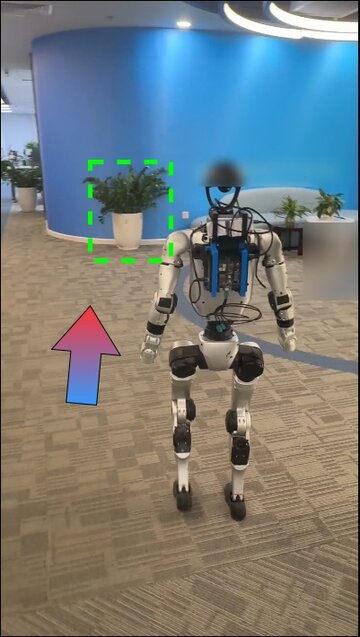
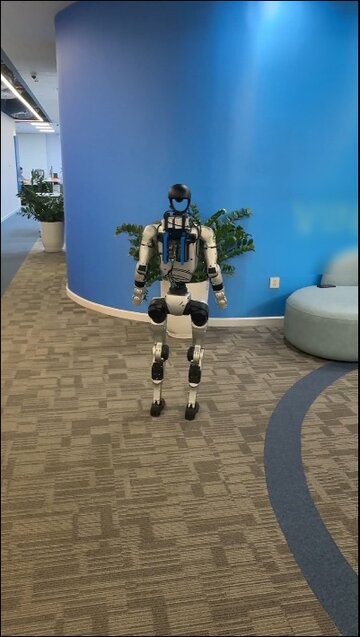
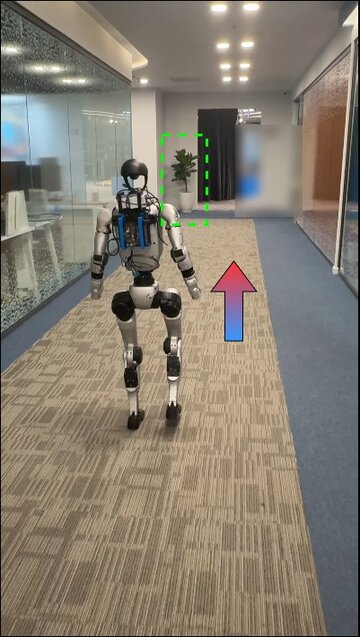
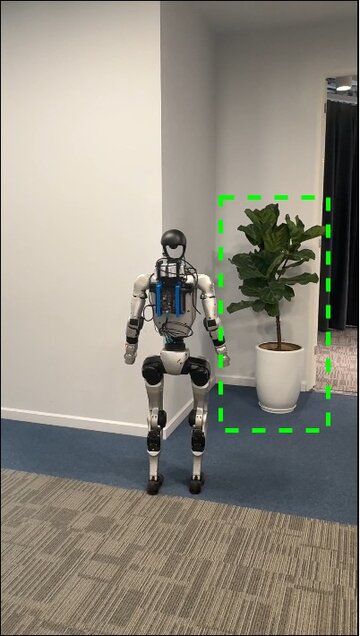
Plants by the blue couch (T2), key moments. The robot turns at the intersection, passes the first plant, and stops in front of the next potted plant near the blue couch.
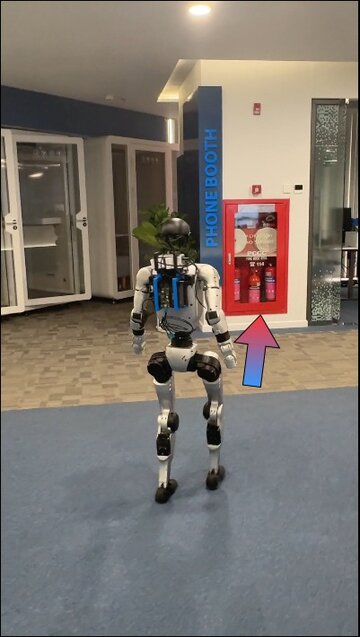
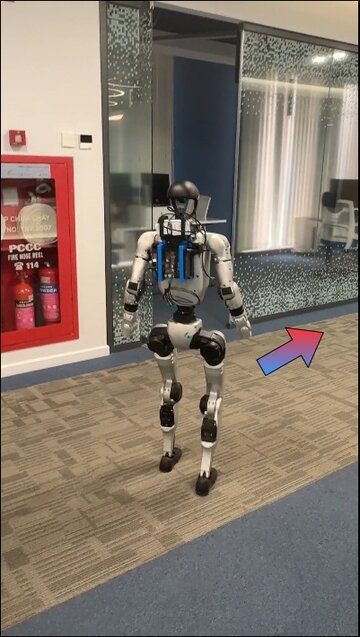
Fire cabinet to the hallway plant (T2, Fig. 7b), key moments. The robot reaches the red fire-extinguisher cabinet, turns right, follows the hallway, and stops at the plant at its end.
1 · go straight2 · turn right3 · hallway4 · stop
Citation
BibTeX
@article{dao2026glancenav,
title = {GlanceNav: Efficient Vision-and-Language Navigation
with Streaming Memory and Counterfactual Rewind},
author = {Dao, Anh and Pham, Quan-Dung and Le, Danh Vinh and
Le, Tuyen Pham and Nguyen, Quan and Shang, Yuzhang},
journal = {arXiv preprint arXiv:2611.30900},
year = {2026}
}